Ziyarat in Baghdad
Abbasid capital on the Tigris, home of the Bayt al-Hikma and the graves of the four deputies of Imam al-Mahdi (a.j.) and Shaykh al-Kulayni.
Prayer times in Baghdad — today's times and the week ahead
Map location
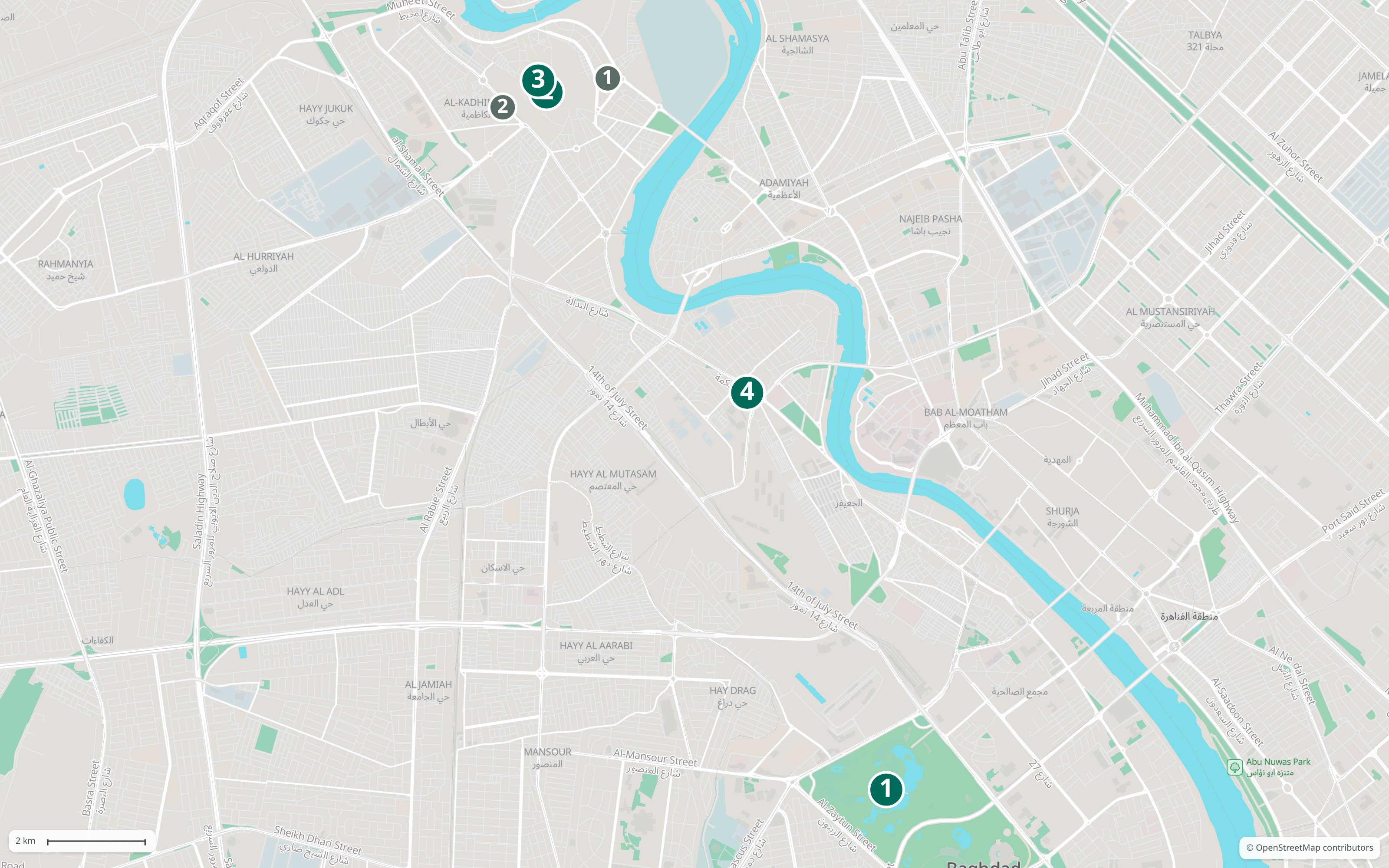
Sacred sites on this map
Points of interest on this map
- Atba Bus, Al Kadhimiyah — Bus terminal
- Garage Syed Mohammad — Taxi & garage
Ziyarat list: sacred sites in Baghdad
- Baghdad Historic Sites
The Baghdad side of the classic Kadhimiya stay: the tombs of the four special deputies (al-nuwwab al-arba'a) who carried the Imam al-Mahdi's (a.j.) office to the community through the Lesser Occultation. The graveyard stations lie scattered on the Karkh side of the Tigris; coordinates are approximate — ask locally.
- Tombs of the Four Deputies — Baghdad
- Masjid Baratha
Historic mosque on the pilgrims' road between Baghdad and Kadhimiya where Imam Ali (a.s.) is recorded to have stopped and prayed on his march to Nahrawan. Traditions gathered by al-Majlisi place the house of Maryam (a.s.) here, the prayers of prophets Ibrahim and Yusha (a.s.), and a spring the Imam brought forth — it has been a station of Shi'a pilgrims for a thousand years.
- Masjid Baratha — Baghdad
- Shrine of Shaykh al-Kulayni
Shrine venerated as the resting place of Shaykh Muhammad ibn Ya'qub al-Kulayni (c. 255–329 AH / 868–941 CE), Thiqat al-Islam, who spent twenty years teaching in Baghdad and compiled al-Kafi — the first of the four books of Shia hadith — from more than fifty teachers across Rey, Qom and Iraq. His grave is honoured inside the historic Jami al-Asifyah on the Rusafa bank of the Tigris, at the head of the Martyrs' Bridge beside the Mustansiriya Madrasa. The mosque began as a Sufi lodge in the late 16th century and took its present shape under the Mamluk governor Dawud Pasha in the 1820s; after long neglect the Shia Endowment restored it in 2014 and returned the grave to pilgrimage, and the mosque now carries two domes and separate prayer halls for men and women. Historians debate the tomb's identity — some honour it as the grave of the ascetic al-Harith al-Muhasibi, and the classical rijal sources record al-Kulayni's burial at the Bab al-Kufa cemetery — so ask your guide on the ground.
- Tomb of Shaykh al-Kulayni — Baghdad